
This post may contain affiliate links. Please read our disclosure policy.
This pan-seared filet mignon recipe is so easy to master and renders perfect filet mignon every single time! While there are plenty of ways to cook tenderloin steak, this technique is the easiest and most repeatable. This recipe has been tested thousands of times by readers and myself with near perfect results every single time.

Filet mignon is known for its tenderness and buttery texture. They have a delicate flavor compared to other cuts of beef, such as pan-seared ribeye or New York strip. It is often considered a luxury cut and is usually reserved for special occasions.
Because filet mignon is a lean cut of meat, it is important to cook it properly to avoid drying it out. I recommend cooking it to medium-rare or medium doneness to preserve its tenderness and juiciness.
If you enjoyed this recipe, I highly recommend you also check out my blueberry glazed filet mignon, balsamic glazed filet mignon, and bacon-wrapped filet mignon. If you’re looking for a good steak to share with a crowd, look no further than my porterhouse steak recipe with dipping sauces or my surf and turf recipe for two! Also, see reverse searing or grilling filet mignon.
Table of Contents
Why This Recipe Works
The secret to cooking the perfect steak is combining pan searing with an oven finish. This gives you a nicely seared exterior (high heat) with a juicy and evenly cooked interior (indirect lower heat). A cast iron skillet allows you to easily transfer your steak from the stovetop to the oven, making this a simple recipe to master.
The overall consistency and predictability of this cooking technique give this recipe a very high success rate on the very first try. I’ve followed it to the T with great success with hundreds of steaks. If this is your first time preparing filet mignon or if you’re struggling to get it right, then this recipe is for you.
Ingredient Notes

- 8-10 ounce tenderloin beef filets (roughly 1.5- 2 inches thick): look for steaks that are about 2 inches thick and appear plump and deep red in color. Avoid steaks with signs of browning or slimy texture.
- Salt and pepper: for seasoning and optional dry brining.
- Vegetable or canola oil: these oils are best for searing because they have a higher smoke point than butter or olive oil.
See the recipe card for full information on ingredients and quantities below.
Prepping and Seasoning Filet Mignon
Remove your steak from the fridge 30-60 minutes (1 hour ideal) before cooking to bring it closer to room temp. This is going to ensure even cooking and more accurate cooking times. Pat the steaks dry with a paper towel and season generously with coarse sea salt or kosher salt and pepper.

Dry Brining Filet Mignon
You can take seasoning one step further with dry brining. Dry brining is the process of drying out the exterior of the steak with salt before cooking, locking in the juices, and enhancing the flavor. To dry brine steak, place the steaks on a wire rack set on a baking sheet and season liberally with coarse sea salt or kosher salt, and pepper. Place the steaks in the fridge uncovered for at least one hour or preferably overnight. The drier steak surface will make for even better crusting.
Steak should still rest on the counter for at least 30-60 minutes before cooking to climatize. No additional salt or seasoning is required.
Step by Step Instructions (With Pictures)
Step 1.
Leave the butter on the counter to soften or place it in a microwave-safe bowl and microwave until malleable, 10-15 seconds. Use a fork to mash in the herbs and garlic until fully mixed. Store in the refrigerator and remove 10 minutes before adding to the filet.

Step 2.
Preheat the oven to 415°F. Remove the steak from the fridge 30-60 minutes before cooking, this is to bring the steak to room temperature and ensure your cooking times are more accurate. Season all sides liberally with salt and pepper. This can be done while your steak comes to room temp.

Step 3.
Add 1 tablespoon of oil (all you need is a very light coating) to an oven-safe cast iron skillet and turn the heat up high, allowing the skillet to become very hot. Twirl the pan to distribute oil as it heats. Once the oil starts to smoke, place the filets face down and sear undisturbed for 2 minutes. Flip the filets and sear for an additional 2 minutes. This will give your filets a nice seared edge.
Quick Tip
Precisely timing your cooking time for steak always yields consistent results. I use my phone to time each side on the skillet and then in the oven. If you adhere to strict cooking times, I promise you will never overcook a steak again.
SMOKE WARNING: Cooking steaks at high temps in a skillet tends to get smokey. Open a kitchen window and turn on your kitchen’s overhead vent fan before you start to help with ventilation.

Step 4.
Optionally add some herb butter and a whole garlic clove/herbs to the pan before transferring it to the oven. The butter will melt and the herbs will season the pan drippings for a later step. Transfer your skillet directly to the oven. [WARNING] skillet may be hot, handle it with oven mitts. For rare, bake for 4 minutes. Medium rare, 5-6 minutes. Medium, 6-7 minutes. Medium well, 8-9 minutes. Remember, depending on the size of the steak, the more or less time it will take. This recipe is ideal for an 8-10 ounce portion, roughly 1.5-2 inches thick.
Step 5.
Optionally spoon some of the seasoned pan drippings over the steak to infuse it with extra flavor.

Step 6.
Remove filets from the skillet and set them on a plate or cutting board and let sit for 5-10 minutes before serving. This is important to bring your steak to its final serving temperature.
Step 7.
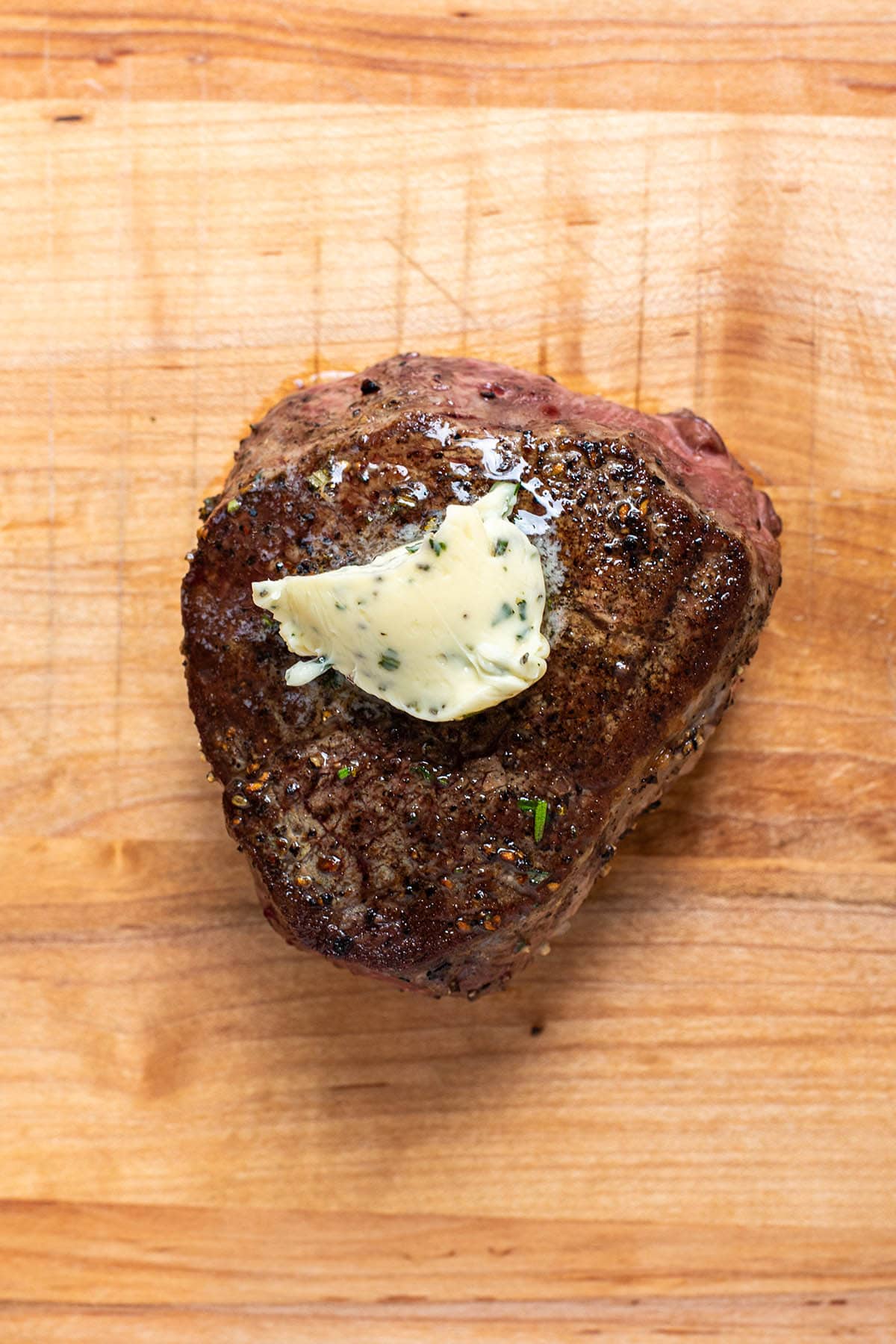
Top with a slice of garlic and herb butter and serve.
Steak Temperature Chart
The timing/temperature chart below corresponds to the pan sear/oven method in this recipe. It’s a great guide assuming you choose a steak of similar size and thickness as listed in the recipe. I recommend a digital thermometer to verify your steak’s internal temperature for the desired level of doneness. Always measure in the middle of the thickest part of the steak.
| Doneness | Internal Temp | Oven Duration |
|---|---|---|
| Very Rare/rare | 120°F to 125°F | 4 minutes |
| Medium rare | 125°F to 130°F | 5-6 minutes |
| Medium | 135°F to 140°F | 6-7 minutes |
| Medium well | 145°F to 150°F | 8-9 minutes |
| Well done | 160°F and above | 10+ minutes |
Let Steaks Rest After Cooking
The legend, Anthony Bourdain once said, the most important aspect of cooking any steak is the rest period after you take it off the heat. Letting a steak rest for 5-7 minutes before cutting is critical for two reasons.
Juice redistribution: during cooking, the heat causes the muscle fibers in the steak to contract, pushing the juices toward the center of the meat. If you cut into the steak immediately after cooking, these juices will spill out, leaving the steak drier. Resting allows the juices to redistribute evenly throughout the meat.
Temperature equalization: resting allows the temperature inside the steak to even out. The outer layers cool slightly while the heat continues to transfer inward, resulting in a more consistent doneness throughout the steak. It’s important to always undershoot your final serving temperature when preparing steak, as the internal temperature will continue to rise as it rests.
What to Serve With Filet Mignon
You can never go wrong with steak and potatoes. Pair this porterhouse steak with my parmesan roasted fingerling potatoes or my garlic butter roasted red potatoes. If you’re looking for ultra-crispy potatoes, try my pesto smashed potatoes! If you prefer mashed potatoes, try my rich and delicious cream cheese mashed potatoes.
My favorite veggie of choice will always be my roasted bacon and parmesan Brussels sprouts. Make this recipe surf and turf with pan-seared lemon butter scallops or baked lobster tails.
Frequently Asked Questions
If you don’t have an oven-safe pan, you can sear your filets on the stovetop and then transfer them to a baking sheet lined with a wire rack. This method works really well at keeping your steaks elevated from the direct heat while in the oven. Just note, this will likely add additional baking time.
If cooking more than 4 steaks on a standard skillet, you may need to adjust the cooking times. I wouldn’t attempt to cook more than 6 filets at a time in a single skillet because the heat loss is going to be too significant.
This is a difficult recipe to pull off for 10-12 people unless you have two skillets. If cooking for a larger crowd I would also suggest reverse searing a whole tenderloin or cooking your steaks on the grill. Learn how to grill your filet mignon here.
More Steak Recipes



Enjoy this recipe? If you made this recipe, please leave a ★ ★ ★ ★ ★ star rating in the recipe card below & a review in the comments!
Filet Mignon

Ingredients
- 4, 10 ounce thick tenderloin beef filets, roughly 1.5- 2 inches thick
- salt and pepper to taste
- 1 tablespoon vegetable or canola oil, can use 1 tbsp butter but it has a lower smoke point
Garlic & Herb Butter
- 1/2 stick of butter, softened
- 1 tablespoon chopped fresh rosemary
- 1 tablespoon chopped fresh tarragon
- 1/2 tablespoon minced garlic
Instructions
For the herb butter
- Leave the butter on the counter to soften or place it in a microwave-safe bowl and microwave until malleable, 10-15 seconds. Use a fork to mash in the herbs and garlic until fully mixed. Store in the refrigerator and remove 10 minutes before adding to the filet.
For the filets
- Preheat the oven to 415°F. Remove the steak from the fridge 30-60 minutes prior to cooking, this is to bring the steak to room temperature and ensure your cooking times are more accurate. Season all sides liberally with salt and pepper. This can be done while your steak comes to room temp.
- Add 1 tablespoon of oil (all you need is a very light coating) to an oven-safe cast iron skillet and turn the heat up high, allowing the skillet to become very hot. Twirl the pan to distribute oil as it heats. Once the oil starts to smoke, place the filets face down and sear undisturbed for 2 minutes. Flip the filets and sear for an additional 2 minutes. This will give your filets a nice seared edge.
- Optionally add some herb butter and a whole garlic clove/herbs to the pan before transferring it to the oven. The butter will melt and the herbs will season the pan drippings for a later step. Transfer your skillet directly to the oven. [WARNING] skillet may be hot, handle it with oven mitts. For rare, bake for 4 minutes. Medium rare, 5-6 minutes. Medium, 6-7 minutes. Medium well, 8-9 minutes. Remember, depending on the size of the steak, the more or less time it will take. This recipe is ideal for an 8-10 ounce portion, roughly 1.5-2 inches thick.
- Optionally spoon some of the seasoned pan drippings over the steak to infuse it with extra flavor.
- Remove filets from the skillet and set them on a plate and let sit for 5-10 minutes before serving. This is important to bring your steak to its final serving temperature.
- Top with a slice of garlic and herb butter and serve.
Notes
Rare: 120°F to 125°F
Medium rare: 125°F to 130°F
Medium: 135°F to 140°F
Medium well: 145°F to 150°F
Well done: 160°F and above
Nutrition
Nutrition information is automatically calculated, so should only be used as an approximation.













I did this last year for New Years Eve, turned out great, doing it again this year, thanks
Thanks Lisa!
Hmmm…wondering if this method would work with pork chops, as long as you are careful to cook them thoroughly?
I’m sure you could. I’ve never tried but I don’t see why not. I’ve never been a pork chop guy.
Hello! I have cooked steaks this way before and it’s amazing! I was just wondering if once you put your filets in the oven if you turn them half way through the cooking time or if that is why you use the foil. I’ve never tried the foil method but am super excited to try it. I will wait to hear back about flipping or not first!
Hi Stephani – no flipping in the oven. Just one turn during the entire process and no touching otherwise!
After searching the internet for “How to cook Filet Mignon in an iron skillet”, your website came up.
I made this on Christmas day – it was PERFECT! Your instructions were spot on!
And it really couldn’t be easier…
I plan to be making filets a lot more often.
Thanks Joe – glad you found me and glad it came out well! It’s so easy.
Amazing. Timed the steps and it turned out perfectly.
I want to note that I tried to give this 5 stars, but it wouldn’t let me! I absolutely give this recipe 5, not 4 stars.
Hmm that’s strange. I should look into that… Glad it worked out well though!
Hi, trying this on Christmas Eve. Do you add the butter and olive olive after the skillet is scorching hot, or do you add the oil and butter and then turn the range on and on high? Thank you for your time.
Hey Ace – I usually add while it’s heating. Once butter is melted and foaming starts to subside you are good to go. Good luck!
I thought the extra time in the oven was due to the number of filets in the pan, not the filet thickness. Please confirm. Thanks!
Yes sorry, you’re correct. Add 2-3 extra minutes when doing six. They’re typically 2-3 inches thick!
How thick are the filets? I am cooking 6 on Christmas Eve. I’ll add the 2-3 minutes to the oven time. I’m looking forward to impressing my guests!
Mine are typically 2-3 inches thick. I would say that is the standard thickness for this recipe. I wouldn’t add any additional time if they fall within that thickness.
Just curious if you could use dry herbs for butter or if I should make a trip to the grocery store! 🙂
Sure, dried herbs wouldn’t hurt but fresh herbs of course are always bettter – esp rosemary since it’s stronger fresh!
This is amazing…so simple yet so elegant! Made them for Fathers Day this past summer and making again tonight for my husbands birthday…thank you!
It’s foolproof right?!
Absolutely fool proof … they were perfect again… no other way to do!
New Years day dinner hero thanks to your great recipe! Bought a whole tenderloin and after cutting up wanted to wow the hubby. Used Avacado oil to have high smoke point and skip the alarm fun, worked great, threw in a nice pat of butter as moved to the oven. Timed to perfection for medium rare. Can’t wait to WOW the rest of the family later this week. Thanks so much for sharing this wonderful recipe, easy to follow too.